
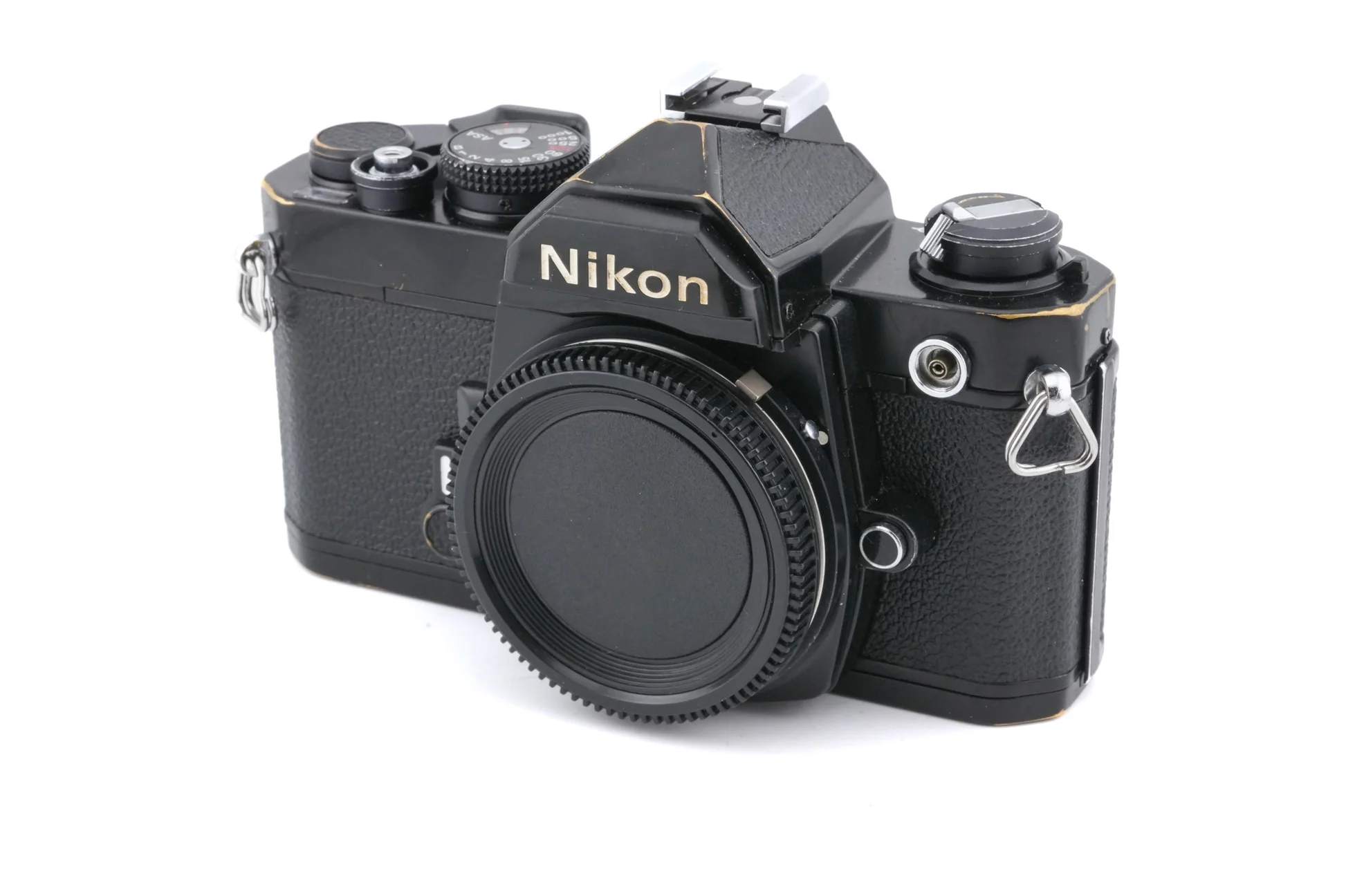
Nikon Cameras FM
1977
The Nikon FM is a mechanically operated, interchangeable lens, 35 mm film, single-lens reflex (SLR) camera. It was made in Japan between 1977 and 1982 by Nippon Kogaku K. K. (now Nikon Corporation).
History
Released in 1977, the FM was the replacement for Nikkormat FT3, which had been introduced only a few months prior. It introduced an entirely new compact, but rugged, copper-aluminum alloy (duralumin) chassis that would become the basis for Nikon's highly successful range of compact semi-professional SLR cameras.
These cameras provided a lower-priced alternative to Nikon's professional F-series cameras, such as the Nikon F2. They were all-new successors to the Nikkormat F- and EL-series of amateur-level SLRs, but despite the lower price-point they continued Nikon's reputation for high-quality construction, impressive durability and measured technical innovation.
The FM proved to be a remarkably long-lived and reliable camera. Over the next twenty-nine years Nippon Kogaku would use the same chassis and basic design philosophy (with some modifications) for the FE (introduced in 1978), FM2 (1982), FE2 (1983), FA (1983) and the limited-production FM3A of 2001.
Design and construction
The Nikon FM in black.
Top view
The FM is manufactured almost entirely from metal and uses a mechanical shutter. It is manual-focus-only, with manual exposure control. Being mechanical, the FM needs no batteries to operate (though two 1.5 volt 357 or 76A or LR44 or SR44 cells are required to operate the light meter). The metering system comprises a gallium photodiode (with 60/40% center-weighting) that meters through-the-lens at maximum aperture. Its reading is displayed by a "center-the-LED" system using vertically arranged light-emitting diodes (LEDs) next to +/O/- markers on the right side of the viewfinder that indicate overexposure, correct, or underexposure, respectively. The photographer adjusts the aperture or shutter-speed until the "O" LED illuminates to indicate correct exposure. This system can be traced back to the Nikkormat FT of 1965 and its "center-the-needle" system. The succeeding Nikon FM2 uses an improved center-the-LED system.
The FM uses a modern titanium-bladed, vertical-travel focal plane shutter capable of speeds from 1 second to 1/1000 of a second, plus bulb. Flash X-sync is at speeds up to 1/125th second.
The body has dimensions of 89.5 mm height, 142 mm width, 60.5 mm depth and 590 g weight. It is available in two finishes; silver with black trim and all black.